VOC Emissions from Crude Storage Tanks: What Permian Producers Need to Know
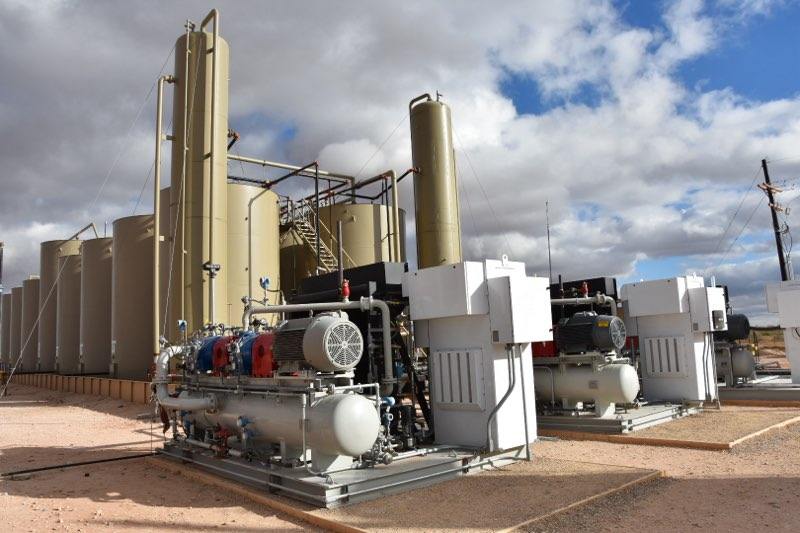
Crude oil from an onshore production well, has a number of other components mixed in with it. Production facilities are built and operated to help separate out other components in the fluid stream. Water, solids and natural gas are easily separated. However, other heavier organic gases can take time to escape the liquid crude oil. These are often known as Volatile Organic Compounds (VOCs), or gas vapors. As crude oil temperature and pressure is reduced from the production in the well, these vapors are released over time as fluid is treated, or settling in storage tanks. If processing equipment is not sealed, these vapors will vent into the atmosphere, or they could be sent to a flare to be burned. However both of these options miss the financial gain of capturing and selling the compounds as well as the environmental benefits from reduced emissions.
VaporLogix provides turnkey solutions for capturing Volatile Organic Compound (VOC) emissions from crude processing facilities. Producers across the Permian and Delaware basins partner with VaporLogix to increase efficiencies in capturing VOCs on production tanks, reduce regulatory issues, and maintain compliant facilities. When looking for a solution to VOC management in West Texas and New Mexico, look no further than VaporLogix.
A large driver for growth in Vapor Recovery is the EPA’s oil and gas methane/VOC rule, 40 CFR Part 60 subparts OOOOb and OOOOc. The final rule was signed on November 30, 2023, and published in the Federal Register on March 8, 2024. The rules update regulations on emissions for new, modified, and reconstructed oil and gas sources. State environmental agencies often act as the permitting and enforcing body for implementation of the requirements. For Permian operators, TCEQ maintains VOC monitoring networks in Midland, Odessa, Goldsmith, and West Odessa. For Delaware operators, the New Mexico Environmental Department oversees compliance, with additional state regulations enforced on top of the federal requirements.. These methane emission and VOC rules are the baseline compliance driver for today’s operators. While Texas is far less aggressive than New Mexico regarding ozone regulation, implementing VOC strategies can help all operators comply, and potentially even recoup additional profits.
When Do VOC Emissions from Crude Storage Tanks Require Additional Vapor Recovery?
If a tank battery constructed, modified, or reconstructed after December 6, 2022 exceeds 6 tpy VOC or 20 tpy methane emissions then it becomes a storage vessel affected facility and OOOOb regulations apply to it. The emissions are calculated based on maximum capacity throughput, not the actual processed volumes in the facility. Once considered an affected facility, the obligation is to cut emissions by 95%, usually by vapor recovery, closed vent systems and other control devices.
However, if an operator can demonstrate with actual monthly throughput data that emissions are below 4 tpy VOCs or 14 tpy methane for 12 consecutive months then it doesn’t require the controls to be installed. This is an ongoing requirement and changes to the wells, facility design and equipment could alter this exemption and have to be considered.
VaporLogix is experienced in equipped to help with all phases of the vapor recovery process. We can advise on decisions affecting compliance, monitor and gather data, and manage all aspects of recovered and captured vapor for an operator.
In brief, here is a rundown of what VaporLogix can deliver:
- System sizing for the actual vapor stream at the site.
- Installation by VaporLogix field crews.
- Capture of vapors that would otherwise be lost.
- Compression of recovered vapors to pipeline-ready conditions.
- Measurement of recovered volume.
- No upfront capital or costs
Anti-petroleum organizations looking to interrupt your presence across West Texas and New Mexico know that VOC (Volatile Organic Compound) storage tanks can be an underestimated source of emissions. Implementing VOC emissions solutions can help combat negative attention or assumptions and increase efficiency, beyond regulatory requirements.
VaporLogix has increased capture efficiency and scf/bbl recoveries by more than 50%. That’s in addition to an average net tank vapor price of more than $3 per MCF. VaporLogix’s systems monitor recovered gas for oxygen concentration to avoid shut-ins and react quickly if gases are not within desired ranges for re-capture.
Tech Stack
In addition to our VRUs and Smart Gas Blanket Systems, we offer a full suite of solutions and services to optimize gas processing. We can assist with contract reviews, verification of settlement statements, manage gas lift and injection, as well as flaring and managing associated produced water.
VaporLogix continues to innovate oil and gas with comprehensive services including full-site development. VaporLogix can help you increase efficiency in VOC capture at your tank sites, leverage our tech for cold-weather uptime advantages, and increase your net price through automated flagging when gas is not up to par, and manage additional services in a facility. Contact us today at 432-618-1549 to start your personalized quote.